
Your ultimate step-by-step guide to planning an unforgettable multi-country European adventure from India, without the stress. We'll cover everything from budgeting in Rupees to tackling that tricky visa, so you can focus on the adventure ahead.
First Steps: Turning Your Eurotrip Dream into a Plan
Forget the movie, let's plan your real adventure! Planning a trip to Europe can feel overwhelming, but it doesn't have to be. The key is making a few important decisions before you even think about booking flights. Use our simple checklist to stay organized from day one and build the trip of a lifetime.
When to Go & For How Long?
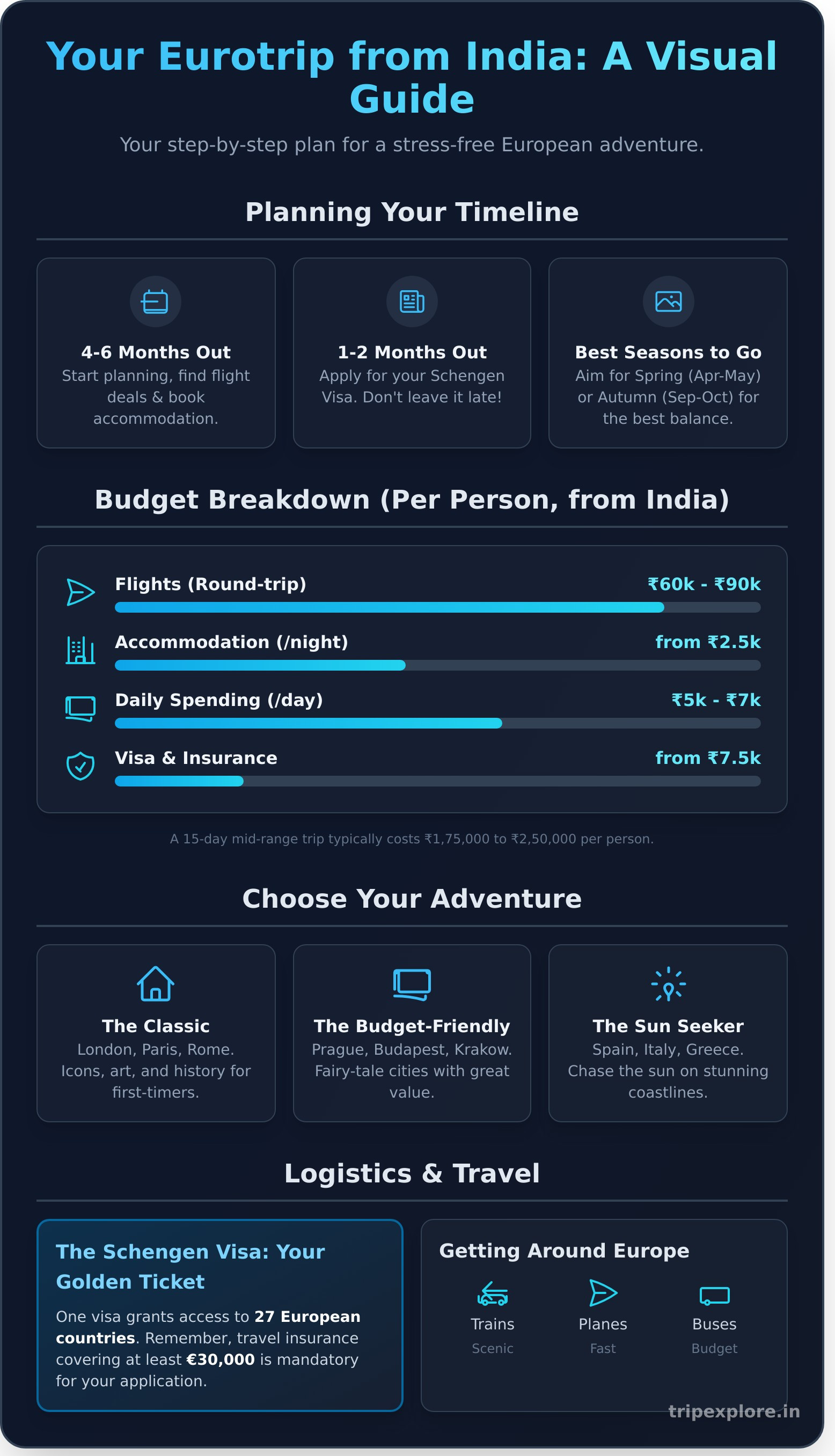
Timing is everything! Europe is beautiful year-round, but the experience changes dramatically with the seasons. Summer (June-August) offers long, sunny days but also brings the biggest crowds and highest prices. For a perfect balance, consider the "shoulder seasons" of Spring (April-May) and Autumn (September-October) when the weather is pleasant, cities are less crowded, and you can often find better deals.
As for duration, a whirlwind 10-day trip can give you a taste of 2-3 major cities. A two-week trip is ideal for exploring a region more deeply, while a month allows for a truly epic, multi-country journey without feeling rushed.
Budgeting Your Eurotrip from India (in Rupees!)
Let's talk money. Your budget will be the backbone of your trip. Here’s a quick breakdown of major costs to consider, converted to Indian Rupees for easier planning:
- Flights: Your biggest initial expense. Expect round-trip flights from India to a major European hub to be anywhere from ₹60,000 to ₹90,000, depending on when you book.
- Accommodation: This varies widely. Hostels can be as low as ₹2,500/night, while mid-range hotels average ₹8,000-₹12,000/night.
- Daily Spending: For food, local transport, and attractions, a good starting point is ₹5,000-₹7,000 per day for a mid-range experience.
- Don't Forget: Factor in visa fees (around ₹7,500), travel insurance, and small city taxes.
Pro tip: A huge benefit of booking a package deal is that it locks in your major costs upfront, making budgeting much simpler and often saving you money in the long run.
Crafting Your Perfect Itinerary: Popular Routes
The best part of planning! Where do you want to go? You can mix and match, but here are a few popular routes to get you started:
- The Classic: Perfect for first-timers. Hit the iconic sights of London, Paris, Amsterdam, and Rome for a journey through history, art, and culture.
- The Budget-Friendly: Get more bang for your buck in Eastern Europe. Explore the fairy-tale cities of Prague, Budapest, and Krakow.
- The Sun Seeker: If you're chasing sunshine and stunning coastlines, head south to Spain, Italy, and the Greek Islands.
The Boring (But Crucial) Stuff: Visas & Bookings
Okay, this is where the planning can feel like work, but getting the logistics right is essential for a smooth trip. We'll simplify the paperwork and booking process so you can get back to the fun stuff.
The Schengen Visa for Indian Citizens: A Simple Guide
The Schengen Visa is your golden ticket to exploring 27 European countries with a single visa. First, figure out which country will be your main destination or your first point of entry, as that's where you'll apply. You'll need key documents like your passport, flight and hotel bookings, travel insurance, and proof of funds. The most important tip? Apply well in advance—at least 1-2 months before your trip—to avoid any last-minute stress. The process can feel complicated, but it's completely manageable. Feeling stuck? Let our experts handle your visa!
Getting There and Getting Around Europe
Once you're in Europe, traveling between countries is surprisingly easy. You have a few main options, each with its own benefits:
- Trains (Eurail): The most scenic and relaxing way to travel. A Eurail pass can be cost-effective if you're planning multiple long journeys.
- Budget Airlines: For longer distances (e.g., Paris to Rome), airlines like Ryanair or EasyJet can be incredibly cheap and fast. Just watch out for baggage fees!
- Buses: The ultimate budget option. Companies like FlixBus connect almost every city and are great for shorter trips.
Where to Stay: Hotels vs. Hostels vs. Airbnb
Your accommodation sets the tone for your trip. Hostels are fantastic for solo travelers and those on a tight budget, offering a great way to meet other people. Hotels provide more privacy and comfort, perfect for couples or families. Airbnb can offer a more local experience, giving you a kitchen and more space to spread out. For a multi-city trip, booking your stays early is crucial, especially during the busy summer months.
The Easy Way Out: DIY vs. a Custom Tour Package
You've got a plan. Now, should you spend hours booking everything yourself across a dozen different websites? Or is there a better way? Let's compare the stress of Do-It-Yourself planning with the ease of a professionally curated package.
Why a Custom Eurotrip Package Saves You Time & Money
Planning a Eurotrip yourself means juggling flights, multiple hotel reservations, train tickets, visa appointments, and tours. It's a lot to handle! A custom package takes all that stress away. You avoid the headache of coordinating 10+ different bookings and get access to deals that online portals simply can't offer. We build a complete plan with your flights, hotels, visa assistance, and tours all included. Best of all, you get to talk to a real human who can tailor the entire trip just for you. Ready to see how easy it can be? Get a FREE custom Eurotrip quote from our experts!
Frequently Asked Questions
How much does a 15-day Eurotrip cost from India?
For a mid-range trip, a good estimate is between ₹1,75,000 to ₹2,50,000 per person, including flights, accommodation, food, and activities. This can be lower if you stay in hostels and higher for luxury travel.
Is Europe safe for solo female travelers from India?
Absolutely. Most of Western and Central Europe is very safe for solo female travelers. As with any destination, it's important to stay aware of your surroundings, especially at night, but you can travel with confidence.
Which are the cheapest countries to visit in Europe?
Countries in Eastern Europe like Hungary (Budapest), the Czech Republic (Prague), and Poland (Krakow) offer incredible value. Portugal is also one of the more affordable destinations in Western Europe.
Do I need travel insurance for a Schengen visa?
Yes, it is a mandatory requirement. You must have travel medical insurance that covers at least €30,000 for your visa application to be approved.
How many months in advance should I start planning a Eurotrip?
For the best prices and less stress, start planning 4-6 months in advance. This gives you plenty of time to find good flight deals, book accommodation, and complete your visa application without rushing.
Your epic European adventure is closer than you think. The key is smart planning, and you don't have to do it alone. We take the hassle out of booking so you can focus on making memories that will last a lifetime. Stop dreaming, start exploring! Build your custom Eurotrip package now!